


Fire containment sheets
Fiprotex S-TYPE

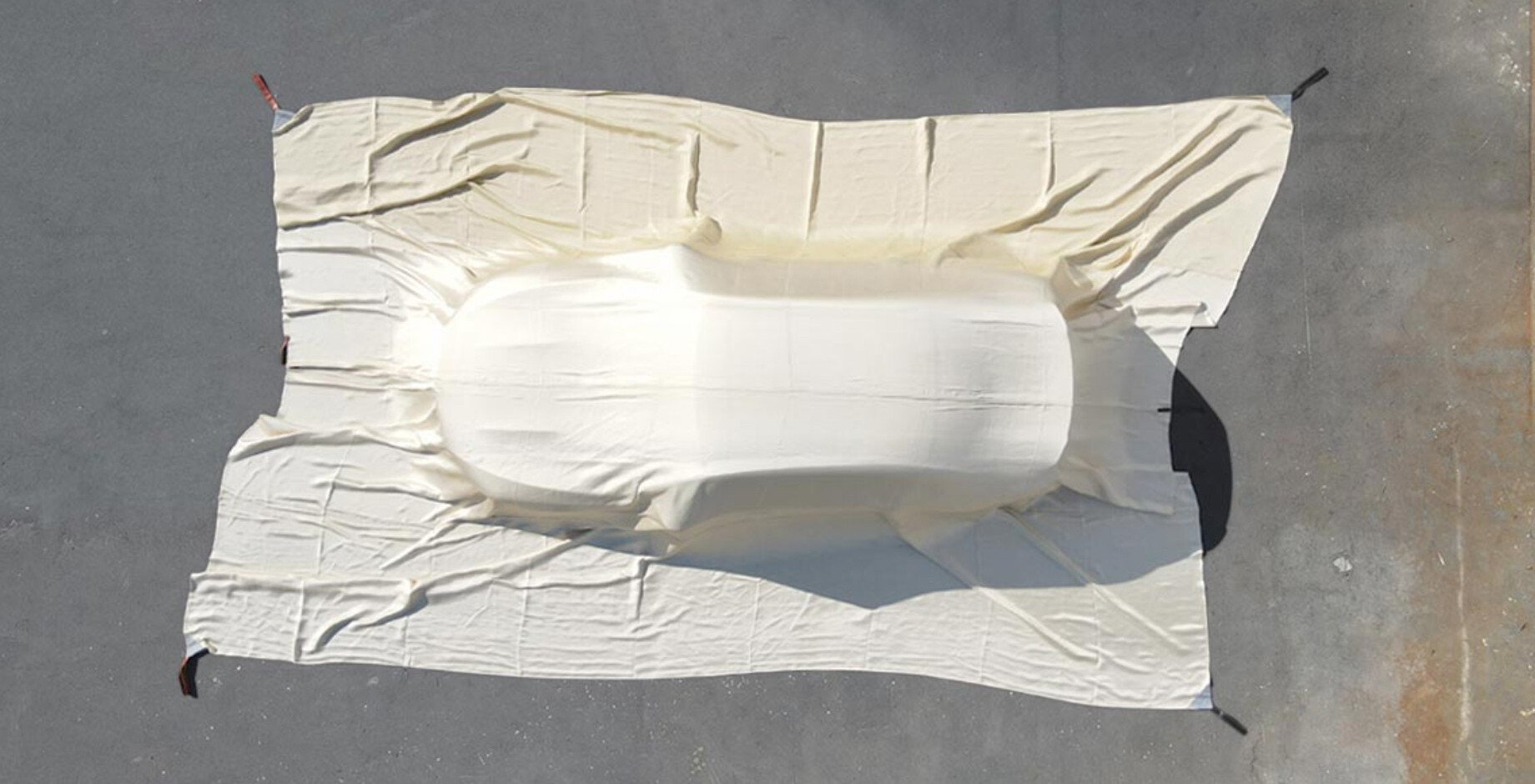
When and where should fire containment sheets be used?
Always and everywhere batteries are stored, charged, or transported – especially when this occurs without supervision or in the case of visible damage. The use of sheets also makes sense when isolating electric vehicles in workshops or during work on energy storage systems, such as stationary storage or PV systems with storage. For rescue services, it is valuable information that such sheets are available at the site.
Can dangerous electrostatic charges occur?
Yes, especially when using inappropriate fire containment sheets with silicone or polyurethane coatings. In such cases, electrostatic charges can build up due to friction when applying the sheet. In the presence of flammable fire gases (e.g., during electric vehicle fires), this can lead to ignition. Therefore, it is necessary to use materials tested for electrostatic properties (e.g., according to DIN 54345-1).
Is there a standard for fire containment sheets?
Yes. The specification DIN SPEC 91489:2024-11 (published in October 2024) describes the requirements for tensile strength, thermal resistance, and suitability for use in electric vehicle fires.
Do fire containment sheets replace traditional extinguishing agents?
No, but they are a very valuable complement. They help prevent the spread of fire, reduce the dispersion of sparks, and protect the surroundings. Proper fire extinguishing remains the task of the fire department or appropriately trained rescue services.
What sizes are fire containment sheets available in?
EVSOLUTIONS Sp. z o.o., as the general distributor, offers a wide range of sizes.
For electric vehicles, e.g.: 8 × 6 m, 9 × 7.5 m, 9 × 10 m, as well as special sizes.
For electric warehouse vehicles (forklifts, etc.), e.g.: 7 × 7 m and 5 × 5 m, as well as special formats.
For lithium-ion batteries (batteries for tools, drive batteries, and all device batteries), e.g.: 1.5 × 1.5 m, 1.5 × 2 m, 3 × 3 m, as well as special sizes.
Who should or can use fire containment sheets?
As part of preventive fire protection, any person who has received appropriate training in its use (e.g., occupational safety specialist, fire protection officer) can use the sheet. In defensive fire protection (from initial fire to developed fire), the use of the sheet is reserved for fire department units and crisis management services.
Is there a difference between sheets for electric vehicles and sheets for lithium-ion batteries?
Yes. Sheets intended for direct use on lithium-ion batteries are made from slightly thicker material (higher weight). The surface weight of such special fabric is about 1150 g/m².
What are the main advantages (USPs) of the S-TYPE sheet?
• Special high-temperature fabric, non-flammable.
• Double-sided, special mineral finish.
• Continuous resistance up to about 1100 °C, temporarily 1200–1300 °C, melting point 1600 °C.
• All seams made with overlaps and sewn with special steel thread.
• Available safety data sheet compliant with EU regulations (safe use, non-flying fibers, skin-friendly).
• High resistance to many chemicals.
• Fire reaction class according to DIN EN 13501-1, class A1 = non-flammable.
• Electrically non-conductive, compliant with DIN 54345-1.
• Partially permeable to fire gases – when used during a fire, the blanket does not create a "balloon" effect.
• Suitable for use with sprinkler systems and extinguishing water.
• Compliant with the DIN SPEC 91489 standard.
• Development, packaging, and production in Germany.
What is the difference between a fire blanket and a fire containment blanket?
A classic fire blanket is designed to cut off the supply of oxygen necessary for combustion, in order to "smother" the flame. The requirements for temperature resistance and tensile strength are generally lower for fire blankets. A modern energy storage system based on lithium-ion technology (Li-ion batteries) cannot be effectively extinguished solely by cutting off the oxygen. Special fire containment blankets are intended to locally contain the fire. In many cases, larger sources of fire – such as electric vehicles or electric forklifts – cannot be safely moved during the incident.
What temperatures can fire containment blankets withstand?
Fiprotex S-TYPE blankets are made of a special high-temperature fabric, also used in the steel and aerospace industries. From a technical perspective, it is a densely woven silicate fabric with a mineral coating on both sides (SiO₂), making it non-flammable. Such a special blanket can continuously withstand temperatures up to around 1200 °C, with a melting point of the material around 1600 °C.
Why are lithium-ion battery fires so dangerous?
In the event of damage, overcharging, or intense heat exposure inside the battery, chemical reactions can occur that may lead to spontaneous ignition – even without an external supply of oxygen. Extremely high temperatures (above 1000 °C) are generated, as well as fire gases that are flammable and, above all, very toxic.
What is "thermal runaway"?
"Thermal runaway" is an uncontrolled chain reaction inside the battery, where the temperature rises exponentially. This reaction cannot be stopped with conventional extinguishing agents and spreads to neighboring cells. In Polish, we refer to this phenomenon as thermal runaway of the battery (thermal "escape" overheating).
What types of batteries exist – and which are the safest?
Lithium iron phosphate (LFP) batteries offer a high level of safety, while lithium cobalt (LCO) batteries have higher energy density but lower stability. S-TYPE products are suitable for various cell chemistries and cover a wide range of applications (see our technical articles).
Reusable fire blankets Fiprotex S-TYPE is made from a special high-temperature fabric, also used in the steel and aerospace industries. This special blanket can continuously withstand temperatures up to approximately 1200 °C, with a melting point of around 1600 °C.
|
|
|
|

Fire behavior tested according to the standard DIN EN 13501-1
Non-conductive, tested according to the standard DIN 54345-145-1
Construction standard compliant with the standard DIN SPEC 91489
Recommendation of suitability CNBOP-PIB No. RP-0026/2025
Underwent three-month testing and are recommended by Mercedes-Benz
What is a fire containment blanket?
Fire containment blankets (KOP) are special blankets made from non-flammable, high-performance materials that help smother flames, reduce thermal radiation, and limit the spread of fire in emergency situations. They serve as both preventive and defensive protection for electric vehicles and devices powered by lithium-ion batteries. The requirements for fire containment blankets are relatively high and have been defined in the DIN SPEC 91489 specification.
Fiprotex S-TYPE - fire containment sheets and battery protection
© 2026 EVSOLUTIONS Sp. z o.o. All rights reserved. Trademarks are the property of their respective entities.
ul. Chabrów 50A 45-221 Opole
Shortcut
Phone
Media